Teltonika FMB965 Impact on a Motorcycle Battery
Comparative analysis of consumption, parking autonomy and wiring alternatives
Key takeaways
- The FMB965 doesn’t directly damage the battery. Its effect is drawing a small amount of energy while the motorcycle is off.
- In Power Off Sleep, reported consumption is below or close to 1 mA at 12V. On a 6 Ah battery, that’s roughly 0.72 Ah per month - about 12% of its rated capacity.
- The impact is low on motorcycles used frequently, and grows when the vehicle sits unused for several weeks without charging.
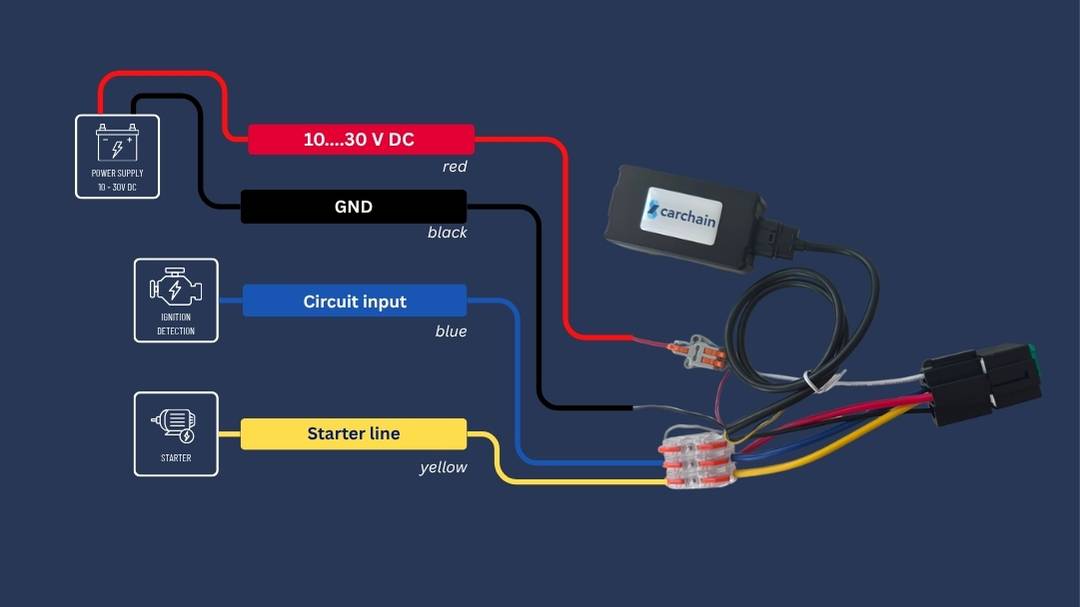
- Wiring it through switched (ignition) power reduces load on the main battery, but limits tracking while the engine is off. The most balanced setup is permanent power for the FMB965, an ignition signal on switched power, and higher-draw accessories run through a relay or switched circuit.
The goal of this analysis is to compare how a motorcycle battery behaves with and without the FMB965 connected, and to explain the effect of using permanent power versus switched (ignition) positive.
1. Scope of the analysis
| Variable | Assumption used |
|---|---|
| Reference battery | 12V, 6 Ah |
| FMB965 idle consumption | 1 mA at 12V, Power Off Sleep |
| Natural self-discharge used in this example | 3% per month |
| Vehicle condition | Engine off, no charging |
| Other accessories | Not included, unless stated otherwise |
These assumptions are used to illustrate orders of magnitude. Real-world autonomy should be validated with an actual standby current measurement.
2. Battery basics
| Concept | Meaning |
|---|---|
| Voltage (V) | System voltage level. Motorcycles are typically 12V. |
| Current (A or mA) | Amount of electricity flowing at a given moment. |
| Capacity (Ah) | Amount of energy available. A 6 Ah battery equals 6,000 mAh of rated capacity. |
| Charging system | With the engine running, the alternator or stator powers the equipment and recharges the battery. |
| Standby consumption | With the engine off, any connected device draws energy stored in the battery. |
A battery can still hold enough voltage to power lights and yet lack the current needed to drive the starter motor.
3. How the FMB965 behaves
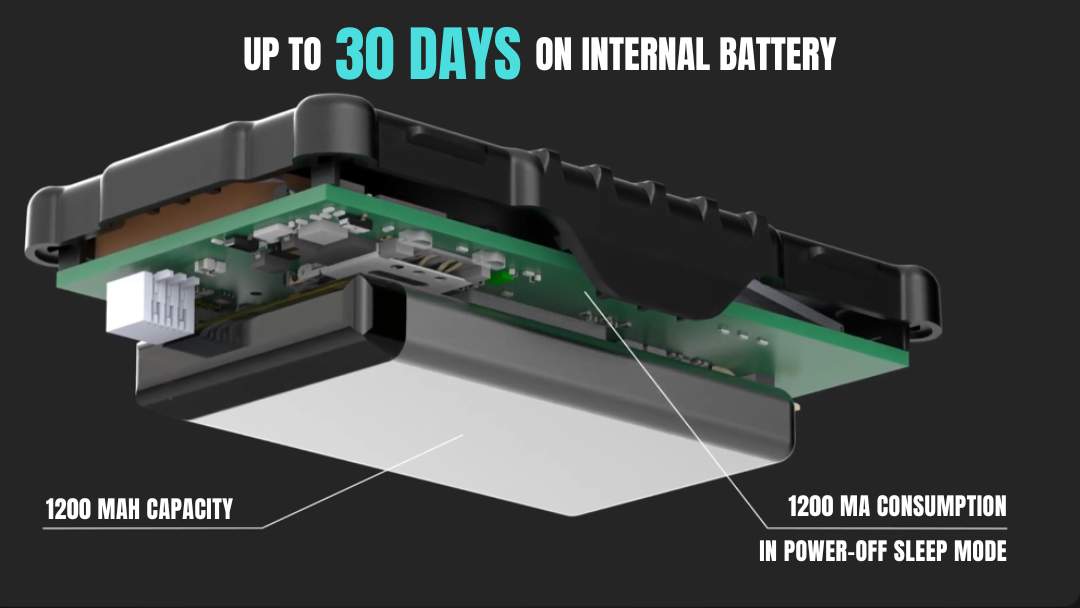
The FMB965 has a rechargeable internal battery of 1,200 mAh. It works as a backup in case of power loss, disconnection or tampering — it does not permanently replace the motorcycle’s battery.
| Operating mode | Current | Daily consumption | 30-day consumption |
|---|---|---|---|
| Power Off Sleep | 1.00 mA | 0.024 Ah | 0.72 Ah |
| Deep Sleep | 2.40 mA | 0.058 Ah | 1.73 Ah |
| Online Deep Sleep | 2.64 mA | 0.063 Ah | 1.90 Ah |
| GNSS Sleep | 6.10 mA | 0.146 Ah | 4.39 Ah |
| Normal operation | 22.82 mA | 0.548 Ah | 16.43 Ah |
| Reporting every 30 seconds | 24.96 mA | 0.599 Ah | 17.97 Ah |
4. Wiring alternatives
| Alternative | Behavior | Advantage | Limitation |
|---|---|---|---|
| Permanent power | The FMB965 stays powered with the engine off. | Keeps tracking and safety features active. | Draws energy while parked. |
| Switched (ignition) power | External power cuts off when the key is removed. | Reduces load on the main battery. | The device relies on its internal battery and loses continuity once that discharges. |
Recommended configuration
- FMB965 with permanent power and a fuse.
- Ignition input wired to switched (key-on) positive.
- Sirens, beacons and higher-draw accessories powered through a relay and fuse, or on switched power, when they shouldn’t run while the vehicle is parked.
5. Cumulative impact on a 6 Ah battery
| Time with the engine off | FMB965 cumulative consumption | Share of a 6 Ah battery |
|---|---|---|
| 1 day | 0.024 Ah | 0.4% |
| 7 days | 0.168 Ah | 2.8% |
| 15 days | 0.36 Ah | 6% |
| 30 days | 0.72 Ah | 12% |
| 60 days | 1.44 Ah | 24% |
| 90 days | 2.16 Ah | 36% |
Cumulative FMB965 consumption as a share of a 6 Ah battery
These figures consider only FMB965 consumption in Power Off Sleep.
6. Comparison: battery with and without the device
| Time without riding | Without FMB965 | With FMB965 in Power Off Sleep |
|---|---|---|
| Start | 100% | 100% |
| 30 days | 97% | 85% |
| 60 days | 94% | 70% |
| 90 days | 91% | 56% |
| 120 days | 88% | 42% |
Battery charge remaining while parked, with vs. without the FMB965
Illustrative estimate assuming 3% monthly natural self-discharge and a 6 Ah battery.
This difference represents a reduction in parking autonomy, not an equivalent reduction in service life measured in years. Service life is mainly affected when a battery stays discharged for long periods or undergoes repeated deep discharges.
7. Impact by usage pattern
| Usage pattern | Estimated impact | Description |
|---|---|---|
| Daily use | Low | Energy used while parked is usually recovered while riding, if the charging system works correctly. |
| Weekly use | Low to moderate | Depends on ride duration and the vehicle’s charging capacity. |
| 15 to 30 days without use | Moderate | Cumulative consumption starts to matter on small or aging batteries. |
| 60 to 90 days without use | High | Can meaningfully reduce the capacity available for starting. |
| Multiple accessories connected | Variable, potentially high | Consumption adds up. Alarms, sirens, beacons and relays can account for more impact than the FMB965 itself. |
8. Recommended checks
- Confirm that the device correctly detects ignition.
- Verify that the FMB965 actually enters Power Off Sleep after the engine is turned off.
- Measure total standby consumption with a clamp meter or multimeter.
- Check battery capacity and condition, especially if it’s old or has a history of deep discharge.
- Check the alternator or stator and the charging voltage.
- Separate FMB965 consumption from that of alarms, sirens, beacons, relays and other accessories.
- For long idle periods, use periodic charging or a battery maintainer.
Conclusion
With correct installation and configuration, the FMB965 draws modest current and is compatible with regular motorcycle use. Its impact becomes significant mainly when the vehicle sits unused for several weeks, the battery has limited real capacity, or other accessories are connected. Permanent power keeps tracking active while parked; switched power prioritizes battery savings but reduces the device’s operational continuity.
Deploying FMB965 devices across a motorcycle fleet?
Book a demo and we’ll help you validate the wiring configuration and monitoring setup for your fleet.
Technical sources
- Teltonika FMB965 Datasheet v2.8.
- Teltonika Telematics Wiki – FMB965 General Description.
- GS Yuasa – technical documentation on battery operation, self-discharge and failure modes.
Figures are estimates and depend on the battery, installation, configuration, temperature and usage pattern.